
Psychological Evaluation
IN DENVER, CO
Collaborative Psychological Assessment for Children, Teens & Adults
Our assessment team provides comprehensive, individualized evaluations for children, teens, and adults. We specialize in Autism, ADHD, trauma, learning disorders, eating disorders, and complex presentations that don’t fit neatly into one category. Every evaluation is collaborative, strengths-based, and grounded in the Therapeutic Assessment model.
We are proud to offer:
- Autism and ADHD assessment across the lifespan
- Diagnostic clarification when past diagnoses haven’t fully fit
- Eating disorder and trauma-focused assessment
- Psychoeducational evaluations for learning disorders, dyslexia, and giftedness
“The goal of Therapeutic Assessment is to help clients grow, not just to diagnose”
~ Stephen E. Finn, the founder of Therapeutic Assessment
Do You Need Clear Answers About Attention, Learning, Emotional, or Developmental Concerns?
When symptoms overlap, change over time, or don’t respond to treatment, it can be hard to know what’s really going on. ADHD can look like anxiety. Autism can look like trauma. Learning differences can look like behavior problems. And mood disorders can be missed or misdiagnosed for years.
If you or your child has been struggling without a clear explanation—or with multiple conflicting diagnoses—you may feel frustrated, discouraged, or unsure of the next step. Many people come to us after trying therapy, medication, school interventions, or quick evaluations that didn’t capture the full picture.
A psychological evaluation provides clarity, direction, and a deeper understanding of what’s beneath the symptoms. And at The Catalyst Center, the process is collaborative, validating, and intentionally therapeutic—not clinical or cold. Learn more about the benefits of a psychological assessment.
Why an Accurate Psychological Evaluation Matters
A clear, accurate diagnosis from a psychological evaluation is the foundation for meaningful treatment. Without it, you may:
- Try strategies that don’t help
- Receive conflicting recommendations
- Wonder if you’re missing something
- Spend time and money on interventions that aren’t a good fit
- Internalize shame or self-blame for difficulties that have a neurobiological or developmental root
Because symptoms often overlap—especially across ADHD, Autism, trauma, anxiety, learning disorders, and mood concerns—an in-depth, team-based evaluation prevents misdiagnosis and brings relief, insight, and a path forward.
A psychological evaluation isn’t just about identifying a diagnosis. Done well, it helps you understand why things are difficult, what strengths you bring, and which next steps will truly support healing and growth.
The Catalyst Center Difference
A collaborative, therapeutic, trauma-specialist approach.
Unlike standard testing centers, our evaluations are grounded in the Collaborative Therapeutic Assessment model—a relational, client-centered approach designed to support healing as well as clarity.
Our evaluations include:
- A team of six doctoral-level psychologists reviewing each case
- Trauma-specialist clinicians skilled in complex presentations
- A collaborative, respectful, non-pathologizing process
- Attunement to neurodiversity, sensory needs, and identity
- Clear, easy-to-understand explanations without jargon
- Personalized recommendations that are meaningful and practical
- Coordination with your care team, school, or providers (with permission)
We specialize in working with nuanced cases where symptoms overlap, past diagnoses don’t fully fit, or a client has been misunderstood or missed by previous providers.
The result: assessments that feel accurate, compassionate, and hopeful—with next steps that are grounded in science and tailored to real life.
Interested in Learning More?
Change Begins Here
Contact Us to learn more about Collaborative Psychological Assessment at The Catalyst Center
What We Can Help Diagnose
Our team draws from comprehensive psychological assessment, psychological testing, and psychoeducational evaluations to clarify a wide range of concerns. A psychological evaluation can clarify a wide range of concerns across emotional, cognitive, and developmental domains.
We offer psychological evaluations for children, teens, and adults seeking clarity around:
- ADHD & executive functioning differences
- Autism Spectrum Disorder (including late-identified autism and missed presentations)
- Learning disorders, dyslexia, dyscalculia, and giftedness
- Mood and anxiety disorders
- PTSD, complex trauma, and dissociation
- Eating disorders and co-occurring conditions
- Diagnostic clarification for complex or overlapping symptoms
Our team also specializes in evaluations where symptoms have been misunderstood as behavior problems, personality issues, or treatment resistance.
Our Psychological Evaluation Specialties
Complex Diagnostic Clarification
Many clients come to us after years of misdiagnosis or stalled treatment. In these situations, a psychological evaluation can help uncover patterns that haven’t been visible through therapy alone and clarify what is truly contributing to long-standing difficulties. Our trauma-specialist team excels at identifying nuanced presentations involving trauma, dissociation, neurodivergence, mood disorders, and attachment patterns, ensuring that clients receive a deeper, more accurate understanding of their experiences.
In many complex cases, symptoms overlap so much that even skilled providers struggle to see what’s truly happening. Trauma can resemble ADHD, autism can be mistaken for anxiety or behavioral issues, and dissociation can look like inattention. Mood disorders may mask learning disabilities. Without a careful differential diagnosis, clients may receive treatments that offer only partial relief—or none at all.
A thorough psychological evaluation brings these patterns into focus. By examining how thinking, learning, emotion, behavior, trauma history, sensory needs, and relational dynamics intersect, we can clarify not just what is happening, but why. This clarity reduces treatment barriers, decreases confusion, and opens the door to interventions that genuinely match the person’s needs.
ADHD Evaluation for Children, Teens & Adults
We frequently work with clients who have explored ADHD independently or received mixed messages from past providers. Our process includes cognitive testing, behavioral measures, and tailored recommendations that help clarify not only whether ADHD is present, but how it shows up uniquely for you.
Autism Assessment (Children, Teens & Adults)
Our team provides comprehensive autism evaluations for children, teens, and adults. We assess for Autism Spectrum Disorder across the lifespan, including presentations that have been misunderstood, missed, or masked. Our approach is neurodiversity-affirming, sensory-informed, and grounded in collaborative, therapeutic assessment practices.
Brief Adult Autism Assessment
For adults who suspect autism or want clarity after years of wondering, we offer a streamlined, expert-led protocol at a more accessible cost. If criteria for ASD are met, you receive a formal diagnosis and personalized recommendations for navigating co-occurring concerns such as trauma, neurodivergence, mood disorders, or learning differences. These tailored insights help you understand how different parts of your experience interact, offering a more comprehensive sense of yourself—and a practical path forward that supports your well-being across home, school, work, and relationships.
If Autism does not appear to be present, we help identify what does explain your experiences.
Learning Disorders, Dyslexia & Giftedness
We provide comprehensive psychoeducational testing, psychoeducational assessment, and giftedness evaluations for reading, writing, and math disorders as well as giftedness identification. Families receive clear recommendations and support for:
-
IEPs
-
504 plans
-
Specialized instruction
-
Accommodations
-
Enrichment planning
Eating Disorder Assessment
Because eating disorders frequently overlap with trauma, neurodivergence, OCD, ADHD, and mood concerns, our evaluations also help clarify the ‘why’ beneath the symptoms. We assess for sensory sensitivities, trauma triggers, personality traits such as perfectionism, over-accomodating, or overwhelm, and emotional processing patterns that may be contributing to the eating disorder.
A comprehensive eating disorder assessment allows us to identify co-occurring diagnoses, determine the most appropriate level of care, and outline a coordinated treatment plan that supports the client’s readiness for recovery. Our approach is compassionate, non-shaming, and designed to give clients, their families, and their care teams a clear understanding of what’s happening and what will truly support healing.
Learn more about our eating disorder therapists and offerings
What the Psychological Evaluation Process Looks Like
Our process integrates psychological assessment, psychological testing, and, when appropriate, psychological screening tools to ensure accuracy.
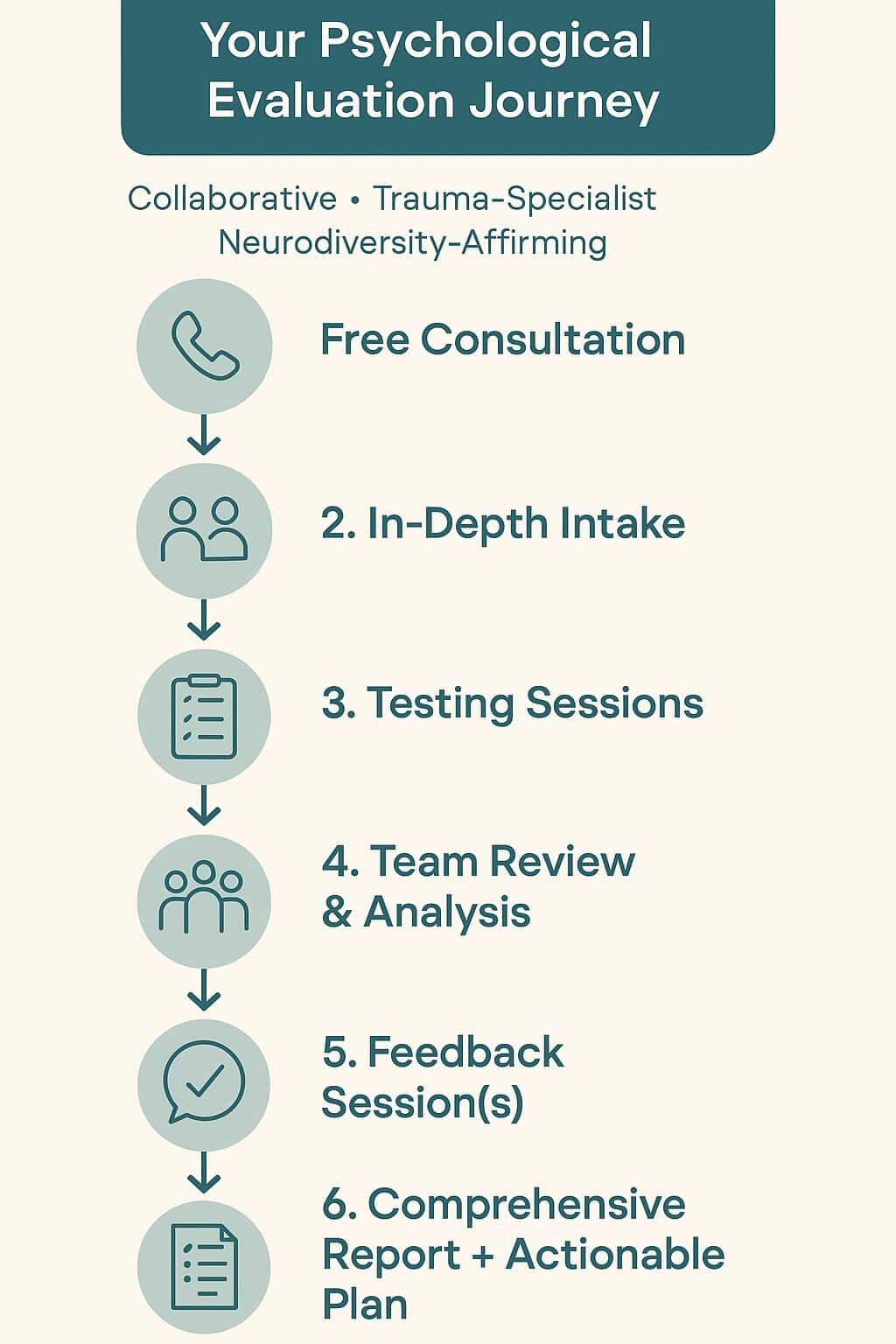
1. Free Introductory Call
Talk with our Intake Coordinator, to share what’s bringing you in, ask questions, and get a sense of whether our approach is the right fit. This call is free and typically 15–20 minutes.
2. In-Depth Intake
This is where your evaluation truly begins. Your psychologist takes a thorough history — covering your symptoms, background, strengths, and goals — and works with you to clarify the questions you most need answered. For children, this includes a parent interview. For adults, partners or family members may be included if helpful. This session is $350.
3. Personalized Fee Estimate
After your intake session, your psychologist will determine the most appropriate testing battery for your specific situation and send you a written fee estimate before any testing begins. You review and confirm the estimate before we proceed — no surprises, no commitments made before you’re ready.
4. Testing Sessions
Using a tailored combination of psychological tests and psychological testing procedures, cognitive measures, behavioral measures, and questionnaires, we gather the data needed to answer your questions. Testing is typically in-person; virtual options are available when appropriate. Children are seen without parents present unless developmentally necessary.
5. Team Review & Analysis
Your evaluator consults with our full team of assessment psychologists to review findings and ensure accuracy—an approach that is rare outside academic centers.
6. Feedback Session(s)
The results are shared in clear, warm, everyday language. For school-aged children and teens, we offer a separate child and teen-friendly feedback session so they can understand their strengths and challenges in a supportive way.
7. Comprehensive Report + Actionable Plan
You receive:
- A thorough report
- A summary letter you can share with school, medical providers, or loved ones
- Specific treatment recommendations
- Supports for home, school, work, and relationships
- Referrals to trusted clinicians, if needed
Most evaluations can be completed within 4–6 weeks with scheduling flexibility.
Common Questions about Assessment
How is The Catalyst Center’s collaborative approach different from a regular psychological assessment?
Psychological assessment is a powerful tool that can provide practical solutions to various clinical and educational situations. It offers insights and details that other methods may not uncover. Moreover, it helps us gather information about our emotions, behavior, thinking styles, coping tendencies, cognitive functioning, or academic abilities. This detailed information can identify strengths and areas for growth, enabling the development of a targeted treatment plan. Assessment findings and related recommendations address areas for growth more effectively and leverage identified strengths to enhance improvement.
The Catalyst Center Assessment team has adopted a model of assessment known as “therapeutic assessment.” Collaborative in nature, therapeutic psychological assessment has several advantages and applications over other types of assessment. This approach is often more thorough and thus can offer a more complete picture of the situation you or your loved ones are encountering. Another unique advantage of this model is it can be applied when assessing individuals, couples, or even entire families.
- From the beginning, there is a focus on maximizing an assessment’s positive, therapeutic impact by getting to know you, your concerns, and biopsychosocial influences.
- We move beyond trying to put a label on you or your child and instead work WITH you collaboratively and respectfully to understand what is working and what is not working in your life, why you’ve gotten stuck in some spots, and most importantly, what we can do to get you unstuck and moving in a healthier direction.
- Your assessor talks and writes in a clear and easy-to-understand manner, translating all the confusing psychology jargon into regular language that everyone can understand.
- Test findings are approachable and easy to understand while providing specific, concrete, and accessible recommendations to help you pursue your goals.
How much does an assessment cost? What is included?
Our assessments are priced based on the type and complexity of the evaluation, at a rate of $250 per hour. The range across our evaluation types runs from $2,250 to $5,000.
We don’t quote an exact fee upfront — and here’s why: we believe the right evaluation is one that actually fits you. Rather than billing a flat rate for a predetermined battery, we begin with a 90-minute intake session ($350) where your psychologist takes a thorough history, clarifies your referral questions, and determines what testing will be most meaningful. After that session, we out together a personalized fee estimate before any testing begins — so you always know what to expect, and nothing comes as a surprise.
What’s included in every evaluation:
• Face-to-face testing sessions
• Scoring and clinical interpretation by your psychologist
• Team review with our full panel of assessment psychologists
• A comprehensive written report
• A feedback session to walk through findings and next steps
• A shareable summary letter for providers, schools, or family members
For pediatric evaluations, if needed, additional time for parent and teacher collateral and record review will be reflected in your individual estimate.
We also offer a brief adult autism assessment protocol for adults who are not seeking academic or workplace accommodations. Please inquire for current pricing on that option.
We do not bill insurance directly. Superbills are available on request for clients seeking out-of-network reimbursement.
Do you take insurance?
We are not in-network with insurance panels. Our assessment services are private pay. If your plan includes out-of-network mental health benefits, you may be eligible for reimbursement. We’re happy to provide a superbill — a detailed receipt with the diagnostic and billing codes your insurance company needs — that you can submit directly to your plan. We recommend calling the member services number on the back of your insurance card to ask about your out-of-network benefits before your intake session, so you have a clear picture of potential reimbursement.
How long does the assessment process take?
Most evaluations are completed within 4–6 weeks from intake to feedback session, depending on complexity and scheduling. The process typically unfolds across three to four appointments: the intake session, one or two testing sessions (sometimes more for complex cases or pediatric evaluations with collateral input), and a final feedback session. We do our best to accommodate scheduling flexibility and to keep waitlist times short. After your intake, your psychologist will give you a clearer timeline based on your specific evaluation type.
Do you do forensics evaluations?
No, we do not offer forensics evaluations. Psychology Today offers an article that discusses Forensic therapy and assessment.
What happens after the assessment is completed?
After testing is complete, you and your psychologist will have a feedback session where findings and recommendations are discussed. Given the collaborative and therapeutic nature of an assessment at the Catalyst Center, we strive to make test findings approachable and easy to understand while providing specific, concrete, and accessible recommendations to help you pursue your individual goals.
A letter that summarizes findings and recommendations will be provided to you, your providers, school personnel if applicable, and anyone else you wish to include.
Meet Our Assessment Team







Hear From Our Psychological Assessment Team
More Than a Diagnosis: Benefits of Psychological Assessment

New Service: Brief Autism Assessment for Adults Exploring Autism Spectrum Disorder

About Collaborative Assessment
Ready to take the next step?
We’re here to help you find clarity, balance, and lasting well-being.
Here are a few easy ways to reach out:
📞 Call 720-675-7123 and press “1” to speak with our intake team.
💬 Prefer online? Fill out the contact form to request an appointment or ask a question.
Or, if you’re ready, click below to schedule a free introductory call at a time that works for you.