
Explaining Autism to Your Child with Higher Support Needs
Simple ways to speak truth, build trust, and honor who they are
When your child receives an autism diagnosis, your first instinct might be to protect them. Especially if your child has higher support needs—if they communicate differently, if they need help with daily routines, or if they struggle in environments that overwhelm their senses—it can feel complicated to know how to talk about the diagnosis.
But here’s the truth: your child deserves to know who they are. Whether or not they understand every word right now, they feel how you see them. And that’s where the most important conversation begins. Not with a definition, but with connection.
1. Speak to your child’s level of understanding, and trust in their awareness
Your child may have limited spoken language. They may not ask direct questions like “What is autism?” but that doesn’t mean they’re unaware. Children are perceptive. They pick up on how others treat them, on the energy of conversations, on unspoken emotions in a room.
You don’t have to wait for the “right words.” You can start with what’s true and simple, and trust in the bond you’ve built with your child.
Try:
“You are autistic. That means your brain works in a special way, and sometimes things feel easier or harder for you than they do for other people. And that’s okay. You are exactly who you’re meant to be.”
Even if your child doesn’t repeat it back or respond, this language lays the groundwork for identity, safety, and self-trust.
2. Use visuals, routines, or sensory-friendly tools to support the conversation
Some children benefit from visual supports, like pictures, social stories, or emotion cards. You might create a simple visual story with photos of your child doing things they love, alongside affirming text.
For example:
- A photo of your child playing with their favorite toy, captioned “I have things I really love.”
- A photo of them with headphones, captioned “Loud sounds can be hard for me. That’s okay.”
- A photo of them smiling with family, captioned “I am loved just as I am.”
Over time, this becomes a narrative they can see and internalize.
An example is attached at the end of this post that you can customize
3. Avoid the trap of “fixing” language
It can be tempting, especially in early stages of diagnosis, to focus on therapies, goals, and “progress.” Try instead to focus on support and celebration, even on the very hard days.
Avoid phrases like:
- “We’re working on fixing that”
- “Once you get better at…”
- “You don’t even seem autistic!”
Instead try:
“Everyone grows and learns in different ways. You’re growing in your way, and that’s just right.”
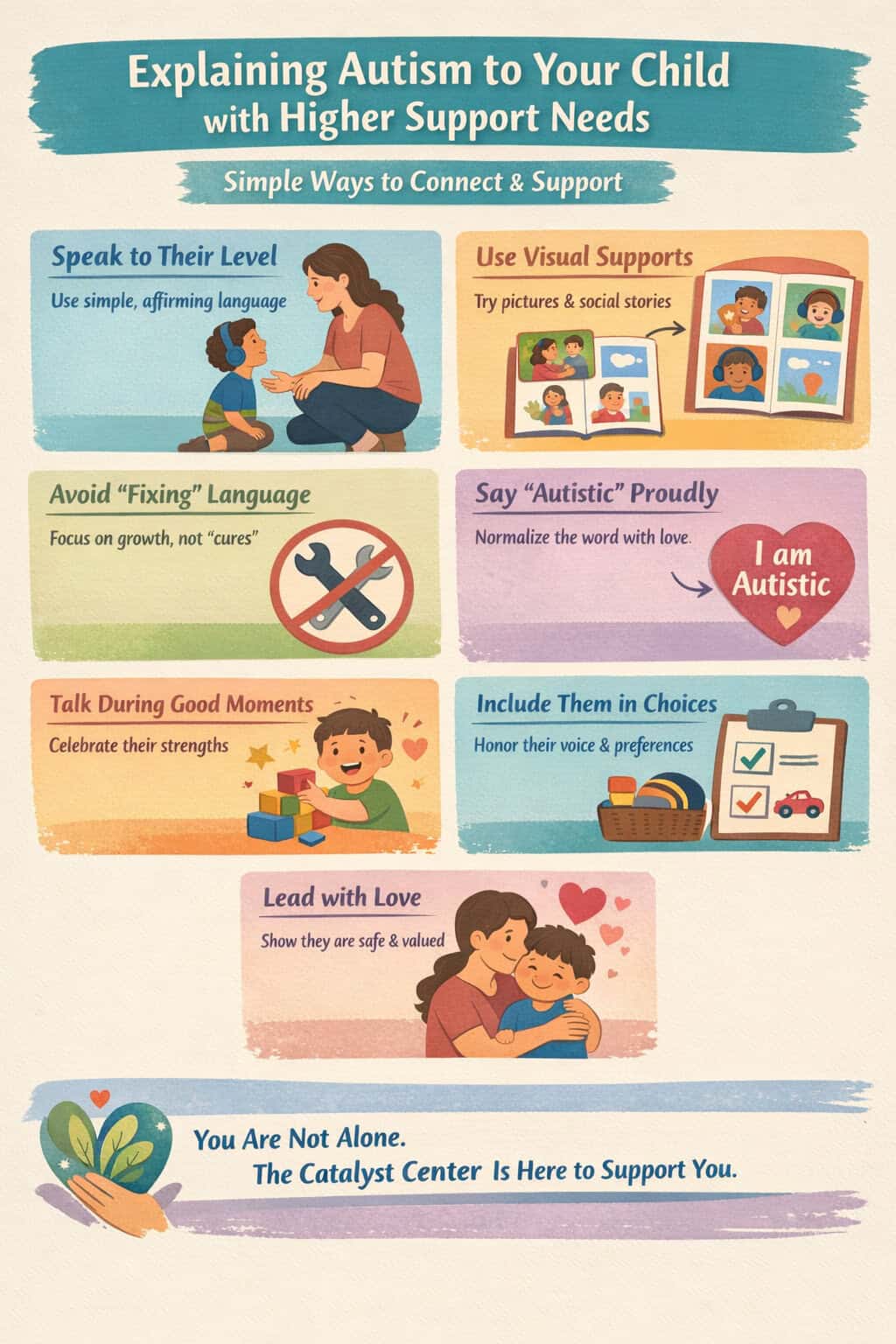
4. Don’t shy away from the word “autistic”
Some parents worry that using the word might be confusing or carry stigma. But saying the word out loud – gently, lovingly, often – is one of the most powerful things you can do. It removes shame. It builds identity.
Even if your child isn’t using that word themselves yet, hearing it spoken with respect helps it become part of their story, not something hidden or scary.
Try:
“Autistic is just one way a brain can be. Your brain is autistic, and it helps you see and feel things in a unique way.”
5. Talk about autism when things are going well
Many conversations about diagnosis happen in moments of stress, like after a meltdown, at an IEP meeting, or in response to a challenge. But your child needs to hear about autism during calm, happy moments too. Make it part of your everyday language, not just a reaction to struggle.
Try saying:
- “You noticed that so quickly! Your brain is so good at patterns. That’s part of being autistic.”
- “You knew you needed a quiet space. Great self-advocating! That’s something a lot of autistic people learn to do.”
6. Include your child in their support team, however that looks
Even if your child doesn’t speak or sign, they still deserve to be part of conversations about their care. Narrate choices. Offer small, manageable options. Acknowledge their preferences and reactions as valid communication.
This builds trust and models respect.
Try:
“We’re going to therapy today to help your body feel calm. I know it’s not your favorite, but we’ll bring your favorite toy and go to the park after.”
7. Let your love lead the way
Above all, your child needs to know that they are loved, safe, and understood. You don’t need a script. You don’t need to explain everything at once. You just need to keep showing up with warmth and honesty.
You can say:
“You are autistic. That is part of you. And I love every part of you.”
Again. And again. And again.
Final Thoughts
Autism is not something your child will outgrow. But neither is their beauty, their strength, their way of being in the world. Telling your child about their diagnosis is not just about information, it’s about identity, dignity, and belonging.
Even if your child never says the words back, they will feel it in your tone, your presence, and your unwavering belief in who they are.
You don’t need to have all the answers. You just need to speak with love.
FAQ
Q: What if my child doesn’t understand the word “autistic”?
That’s okay. Understanding evolves over time. Use the word anyway, and pair it with simple, positive language they can access. Repetition, visuals, and association with safe feelings help build understanding over time.
Q: What if my child has big behaviors? Will they even care about a “label”?
Children may not ask for the language explicitly, but they still benefit from having it. Understanding autism helps you respond with more clarity and compassion, and it creates a foundation for your child to develop a strong sense of identity as they grow.
Q: What if I feel grief or overwhelm?
That’s real. And it’s okay to feel it. But make sure your child receives a message of acceptance and pride. Seek your own space for processing with trusted adults or professionals so you can show up grounded for your child.
Q: Should I wait until my child can ask or understand more?
No need to wait. Speaking about autism now plants seeds for future understanding. You’re building a foundation of honesty and respect—and that matters at every developmental stage.
Here’s a sample social story using clear, affirming language and simple structure. It includes bolded headings and short, sensory-friendly sentences to help with accessibility.
🧠 My Brain is Autistic
A Social Story About Me
I am me.
I have my own smile, my own laugh, and my own way of doing things.
My brain is autistic.
That means my brain works in a different way.
It helps me see the world in a special way.
Sometimes I like things the same every day.
That helps me feel safe and calm.
New things can feel hard. That’s okay.
Sometimes I need breaks.
Loud sounds, bright lights, or too many people can feel like too much.
Taking a break helps my body and brain feel better.
Sometimes I do things in my own way.
I might flap, spin, jump, or make sounds.
That’s called stimming.
It helps me feel good and focused.
I might not always use words to talk.
But I always have things to say.
I use my voice, my hands, my eyes, or my body to tell people what I need.
Being autistic is just one part of me.
It’s not bad. It’s not wrong.
It’s just me.
I am learning every day.
I learn in my own way, at my own speed.
And I’m really good at being me.
I am loved.
I am safe.
I am exactly who I’m meant to be.
Tips for Use:
- Read the story aloud with your child during a calm time.
- Pair with real-life photos (e.g., your child wearing headphones, taking a break, doing something they love).
- Use gestures, visuals, or signs alongside the story if your child uses AAC or other nonverbal communication methods.
- Print and laminate for repeated use.
Ready to get started?
If you’re navigating these conversations and want support along the way, you don’t have to do it alone. The team at The Catalyst Center is here to walk alongside you with care, respect, and understanding. We also offer comprehensive psychological assessment focused on neurodivergence and associated concerns.