
Discernment Counseling
IN DENVER, CO
Discernment Counseling at The Catalyst Center
At The Catalyst Center, our couples therapists offer Discernment Counseling as a structured, compassionate approach for partners who feel uncertain about the future of their relationship. This short-term process creates space to slow down, reflect, and understand what has brought the relationship to this crossroads—without pressure to rush toward a decision.
Whether through traditional couples therapy or discernment counseling, we support couples in Denver, CO (and across Colorado via telehealth) who are navigating mixed feelings about staying together, separating, or exploring what repair might require.
“The goal is for you to gain clarity and confidence about a direction, based on a deeper understanding of your relationship and its possibilities for the future.“
What Is Discernment Counseling?
When partners find themselves unsure about whether to stay together or separate, the uncertainty itself can feel overwhelming and disorienting. Discernment Counseling offers a structured and compassionate way to pause, reflect, and thoughtfully consider the different paths your relationship could take.
This approach is specifically designed for couples in which one partner feels uncertain or ambivalent (“leaning out”) while the other hopes to repair and rebuild (“leaning in”). Instead of moving prematurely into traditional couples therapy, Discernment Counseling creates space for both partners to explore their differing perspectives without pressure.
The aim is to help both partners gain clarity and confidence about the next step—grounded in a deeper understanding of the relationship, the patterns that have shaped it, and what may be possible moving forward.
Who Discernment Counseling Is For
Couples at a Crossroads
Discernment Counseling is designed for couples who feel uncertain about the future of their relationship. It is especially helpful when partners feel stuck between staying and separating, yet do not feel ready to make a final decision. Rather than pushing couples toward repair—or into separation—it offers a calm, structured space to understand what is happening in the relationship.
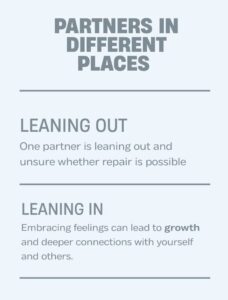
When Partners Are in Different Places
Many couples find Discernment Counseling supportive when:
-
One partner is leaning out and unsure whether repair is possible
-
The other partner is leaning in and hoping to rebuild
-
Communication feels tense, shut down, or difficult
-
A recent crisis, betrayal, or major stressor has disrupted the relationship
-
Longstanding patterns of distance or conflict have created uncertainty
-
Traditional couples therapy feels premature or overwhelming
When Clarity Is Needed Before a Decision
This approach can also be helpful when partners:
-
Want to understand their individual contributions to current patterns
-
Need time, space, and clarity before deciding on separation
-
Hope to reduce conflict and approach decisions more thoughtfully
-
Want to explore options without pressure or urgency
A Focus on Clarity, Not Quick Solutions
Discernment Counseling focuses on clarity rather than immediate solutions. Because of this, it is well-suited for couples navigating emotional ambivalence, mismatched hopes, or complex life circumstances that make decision-making difficult.
While some couples ultimately choose separation and others choose repair, Discernment Counseling provides a respectful environment for partners to reflect on their needs, values, and hopes for the future—together and individually.
How Discernment Counseling Works
The Three Paths
Discernment Counseling supports couples in thoughtfully exploring three possible directions for the relationship. Each path serves a different purpose and allows partners to make choices with greater clarity rather than from urgency or overwhelm.
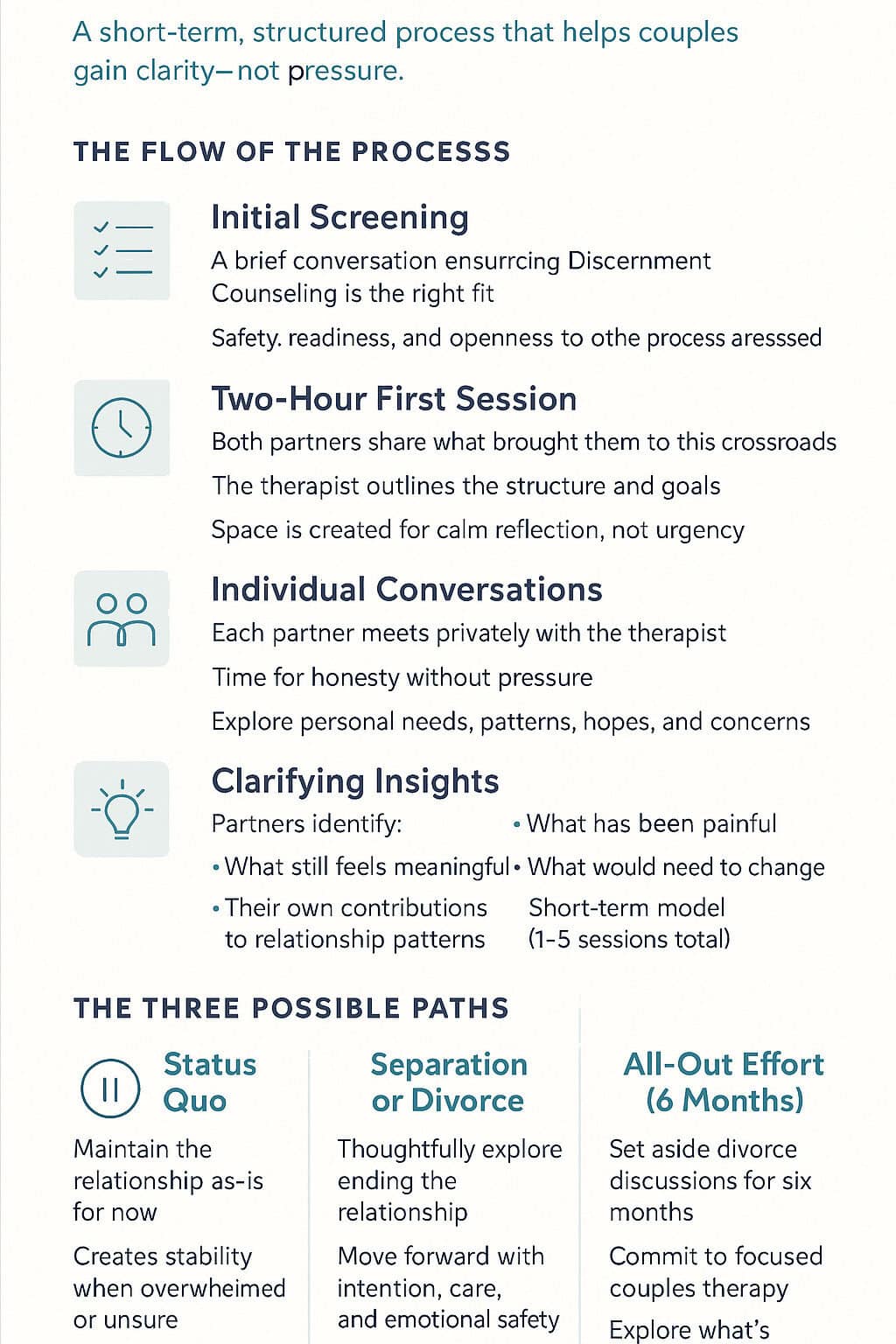
Path 1: Status Quo: Choosing to maintain the relationship as it is for a period of time.
This option can offer stability when one or both partners feel overwhelmed, are navigating significant stressors, or need space to regulate and reflect before making a major decision.
Path 2: Separation or Divorce: Moving toward a planned separation or divorce.
For some couples, clarity emerges that ending the relationship is the most respectful or sustainable choice. This path focuses on understanding how the relationship reached this point and approaching separation with intention, care, and emotional safety.
Path 3: All-Out-Effort: A six-month commitment to focused couples therapy.
Divorce discussions are set aside so partners can fully engage in rebuilding the relationship, addressing long-standing patterns, and exploring what may be possible when both people are invested in change.
Change Begins Here
Interested in learning more about Discernment Counseling and how it can support you?
What Sessions Look Like
Individual and Shared Conversations
Discernment Counseling begins with both partners together. From there, much of the deeper work takes place in individual conversations with the therapist. Because partners often arrive in different emotional places—one feeling uncertain or “leaning out,” the other hoping to rebuild—this structure allows each person to reflect openly without pressure.
Individual conversations help partners:
-
Speak honestly about their experience
-
Reflect on what has been painful or confusing
-
Explore what they need to feel safe, grounded, and clear
Clarity, Not Quick Fixes
The purpose of Discernment Counseling is not to solve every relationship problem. Instead, the focus is on understanding whether those challenges are workable and what meaningful change would require. Throughout the process, the therapist maintains a compassionate, non-judgmental stance that honors the complexity of both partners’ feelings.
Partners can also expect support in:
-
Identifying what still feels important or hopeful
-
Understanding their own contributions to current patterns
-
Gaining insight that supports healthier decisions moving forward—together or apart
This structure helps each partner gain clarity while ensuring both people feel respected and heard.
Structure & Length of the Process
Getting Started
Discernment Counseling begins with a brief screening to ensure the model is the right fit for the couple’s current situation. If appropriate, partners schedule a two-hour first session. This extended format allows both individuals to share their perspectives, understand how they arrived at this crossroads, and begin clarifying what they need.
Session Length and Decision Points
Each session follows a clear structure. After every meeting, the couple decides whether they want to continue. The process includes up to five sessions and is intentionally short-term, offering support and reflection without pressure to commit to long-term therapy before clarity emerges.
The Three Possible Paths
During the process, couples explore three potential directions:
-
Path 1: Status Quo — maintaining the current state of the relationship for now
-
Path 2: Separation or Divorce — thoughtfully considering and preparing for separation or divorce
-
Path 3: All-Out Effort — committing to six months of focused couples therapy
This structure helps partners make decisions from a grounded, reflective place—one that honors both individuals’ needs and the complexity of the relationship.
When Discernment Counseling Is Not Appropriate
Discernment Counseling works best when both partners feel uncertain about the future and are able to participate willingly. However, there are situations where this model is not the right fit.
It is not recommended when:
- A partner has already made a final decision to divorce.
The process requires openness to exploring multiple directions. - Someone feels pressured or coerced to attend.
Discernment Counseling relies on voluntary participation from both partners. - There are concerns about emotional or physical safety.
This includes domestic violence, significant power imbalances, or environments where honesty may not feel safe.
In these situations, safety, stabilization, or alternative forms of support need to be prioritized before making decisions about the relationship.
Meet Our Discernment Counseling Therapists

Katie Godfrey, PhD, LMFT

Dorothy Moon, PsyD, LCP
You Don’t Have to Make This Decision Alone.
It can be difficult to face relationship crossroads without guidance. If you’re unsure which direction to move toward, we invite you to reach out to explore whether Discernment Counseling can support your decision-making process.
Here are a few easy ways to reach out:
📞 Call 720-675-7123 and press “1” to speak with our intake team.
💬 Prefer online? Fill out the contact form to request an appointment or ask a question.
Or, if you’re ready, click below to schedule a free introductory call at a time that works for you.