
Introduction: When the Answer Isn’t Obvious
In Part 1, we explored why attention and executive functioning difficulties aren’t always caused by ADHD.
We reviewed common ADHD mimickers — including anxiety, trauma, autism, depression, learning differences, and sleep challenges — and why screeners alone can’t explain the full picture. Many people meet criteria on paper, yet their lived experience tells a more complicated story.
When symptoms overlap, fluctuate across settings, or don’t respond to treatment as expected, it becomes clear that a single label may not be enough. In these situations, collaborative psychological assessment offers a thoughtful path forward — one that prioritizes understanding over assumption. Findings provide more insight into best supports, a client’s difficulties, and strengths.
What Is Collaborative Psychological Assessment?
Collaborative psychological assessment is a client-centered approach to understanding cognitive, emotional, and executive functioning patterns.
Rather than starting with a fixed diagnosis, assessment begins with shared curiosity. Clients, families, and clinicians work together to explore questions such as:
- Is this ADHD, something else, or a combination?
- Why do symptoms look different at home, school, or work?
- When did these challenges first emerge?
- What supports have helped — and what hasn’t?
Psychological testing for ADHD becomes one part of a broader conversation that integrates history, context, strengths, and lived experience.
Why a Team-Based Approach Matters
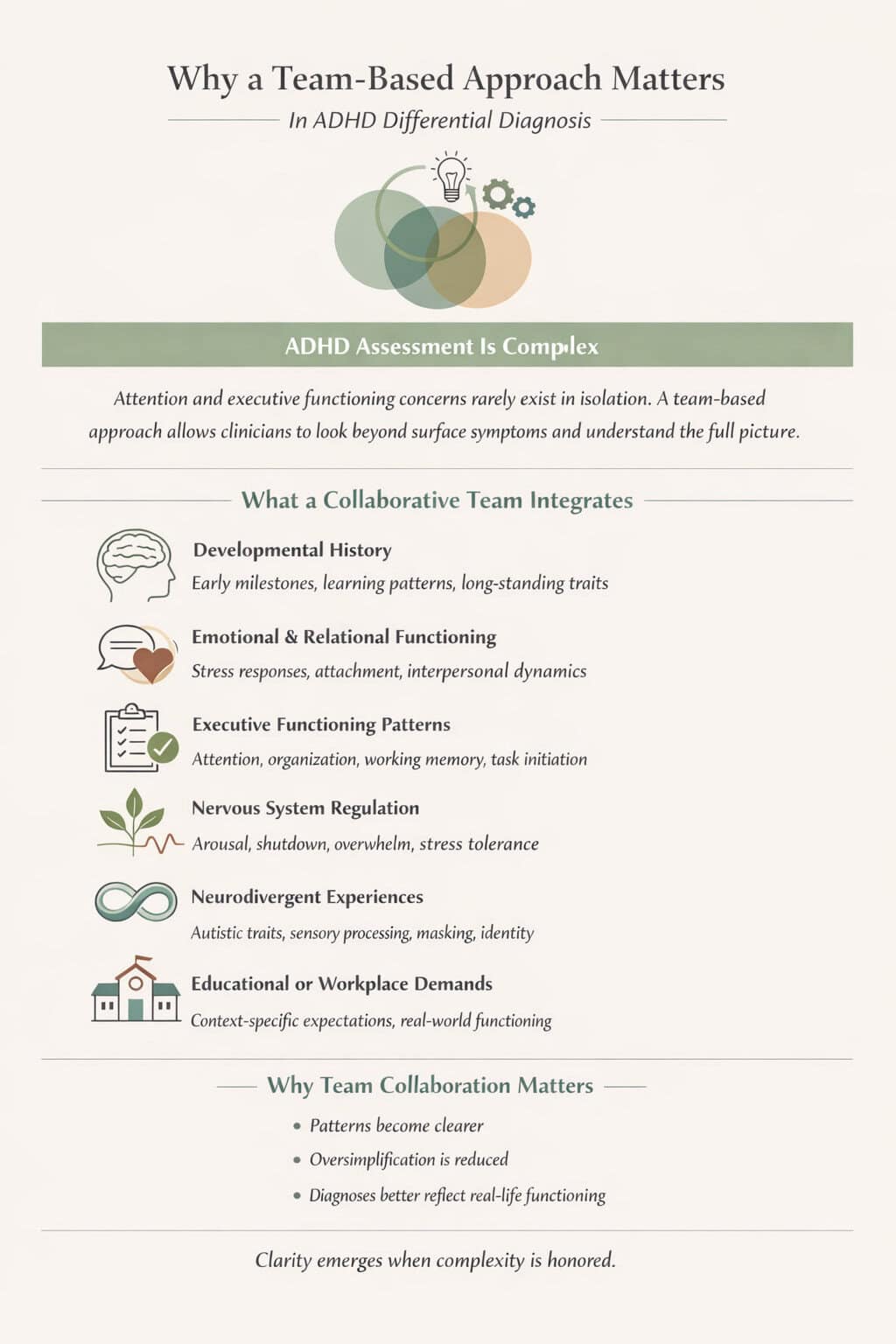
ADHD differential diagnosis is often complex.
At The Catalyst Center, attention and executive functioning concerns are rarely evaluated in isolation. Clinicians regularly consult as a team, allowing multiple perspectives to inform the assessment process.
This approach helps integrate information related to:
- Developmental history
- Emotional and relational functioning
- Executive functioning patterns
- Nervous system regulation
- Neurodivergent experiences
- Educational or workplace demands
When clinicians collaborate, patterns become clearer. Oversimplification is reduced, and diagnostic conclusions are more likely to reflect real-world functioning.
Looking at Patterns — Not Just Test Scores
Collaborative psychological assessment is not only about identifying what’s difficult; it is also about understanding what’s working.
Rating scales and attention tasks are treated as data points, not definitive answers.
They are interpreted alongside:
- Life context and current stressors
- Environmental demands
- Co-occurring mental health concerns
- Areas of resilience and strain
This pattern-based lens is especially important when ADHD mimickers are present. A single score rarely explains how someone functions across daily life.
Identifying Strengths — Not Just Challenges
Collaborative psychological assessment is not only about identifying what’s difficult; it is also about understanding what’s working.
Assessment often highlights cognitive strengths that may have been overlooked, such as strong verbal reasoning, creative problem-solving, visual–spatial skills, persistence under pressure, or the ability to hyperfocus on areas of interest. These strengths can exist alongside executive functioning challenges and are just as important to name.
When strengths are clearly identified, support can be built around how someone naturally learns, processes information, and stays engaged. For many clients, this strengths-based understanding is both validating and empowering — reframing assessment as a tool for self-knowledge, not just symptom identification.
Making Room for “Both / And” Diagnoses
Collaborative assessment allows for nuanced conclusions, including:
- ADHD and anxiety
- Autism and trauma-related stress
- Learning differences and executive functioning challenges
Rather than forcing symptoms into a single category, this approach reflects how human brains actually work. Importantly, this clarity directly informs treatment planning.
How Psychological Assessment Guides Treatment
Assessment is often recommended when:
- Symptoms appeared suddenly or after a major stressor
- Attention differs significantly across settings
- Anxiety, shutdowns, or overwhelm are prominent
- Autism traits or sensory sensitivities are suspected
- Learning challenges or school avoidance are present
- Previous treatment has not helped or worsened symptoms
- There is uncertainty before starting or changing medication
In these cases, slowing down can prevent years of trial-and-error.
When Psychological Assessment Is Especially Helpful
Assessment helps ensure that next steps are intentional rather than reactive.
Clear findings can guide:
- Thoughtful medication decisions
- Therapy approaches that match underlying drivers
- Appropriate school or workplace accommodations
- Executive functioning supports aligned with real needs
- Strength-based strategies that increase sustainability
Even when ADHD medication is appropriate, assessment often clarifies what additional supports are needed for meaningful progress.
The Goal Is Understanding — Not Just a Label
A diagnosis is a tool, not the destination.
The goal of collaborative psychological assessment is to understand what is happening across the brain, nervous system, and lived experience so care can be truly individualized. When people feel accurately understood, support becomes more effective and less overwhelming.
Key Takeaway
Executive functioning challenges are real. However, they don’t always mean ADHD — and that distinction matters.
When symptoms are complex or unclear, collaborative psychological assessment offers clarity rooted in understanding rather than guesswork.
Ready to get started?
If you’re feeling uncertain about whether ADHD fully explains what you or your child are experiencing, a comprehensive assessment can help bring clarity. Our collaborative assessment team at The Catalyst Center is here to help you understand the full picture and make informed, confident next steps.