
When Birth Doesn’t Go as Planned: EMDR for Birth Trauma
Birth is supposed to be one of the most meaningful days of your life. However, for many parents, it becomes something else entirely — frightening, disorienting, or even life-threatening.
You can leave the hospital with a healthy baby and still feel like something inside you never came back online.
Birth trauma is not just “a hard birth.” Instead, it happens when your nervous system becomes overwhelmed — by fear, pain, unexpected medical interventions, or moments where you felt powerless, unheard, or unsafe.
At the same time, parenthood does not pause for recovery. You are expected to feed a newborn, return to work, support your relationship, and somehow move on while your body and brain remain stuck in survival mode.
This is where EMDR for birth trauma can become a lifeline.
Why Birth Trauma Sticks — Even When You Think You Should Be “Over It”
Birth trauma lives in the body. Even when the danger has passed, your nervous system may still act as if it is happening.
For example, it can show up as:
- Feeling panicked when your baby cries
- Avoiding medical appointments
- Flashbacks or intrusive memories
- Feeling disconnected from your partner or baby
- Irritability, shutdown, or emotional numbness
- Guilt for “not being grateful enough”
- A sense that you are not yourself anymore
These reactions are not character flaws. Rather, they are your nervous system’s attempt to protect you after something overwhelming.
EMDR works differently than traditional talk therapy. Instead of talking about the trauma, it uses bilateral movement to help your brain and body reprocess the experience so it no longer feels present and threatening. (For more information about how EMDR works, visit the EMDR International Association: https://www.emdria.org)
As a result, you can move forward without your body reacting as though the danger is still happening now.
How EMDR for Birth Trauma Helps Birthing Mothers
For birthing mothers, trauma often begins in moments when things spiraled out of control.
There may have been a sudden emergency. You might have felt dismissed or ignored. Perhaps the pain felt unmanageable. Some mothers endured procedures they did not fully consent to. Others remember the terrifying thought, “I might die” or “my baby might die.”
EMDR allows you to revisit those moments safely, without reliving them.
During sessions, your brain and body completes the processing it could not finish in the moment. Because of this, many mothers experience a profound shift:
- The memory loses intensity
- The body stops reacting as if danger is current
- You feel more grounded and present
- Bonding with your baby becomes easier
- Positive beliefs about yourself like “I have choice,” “I can trust my body,” “I am safe now,” “I can handle whatever comes up” feel true
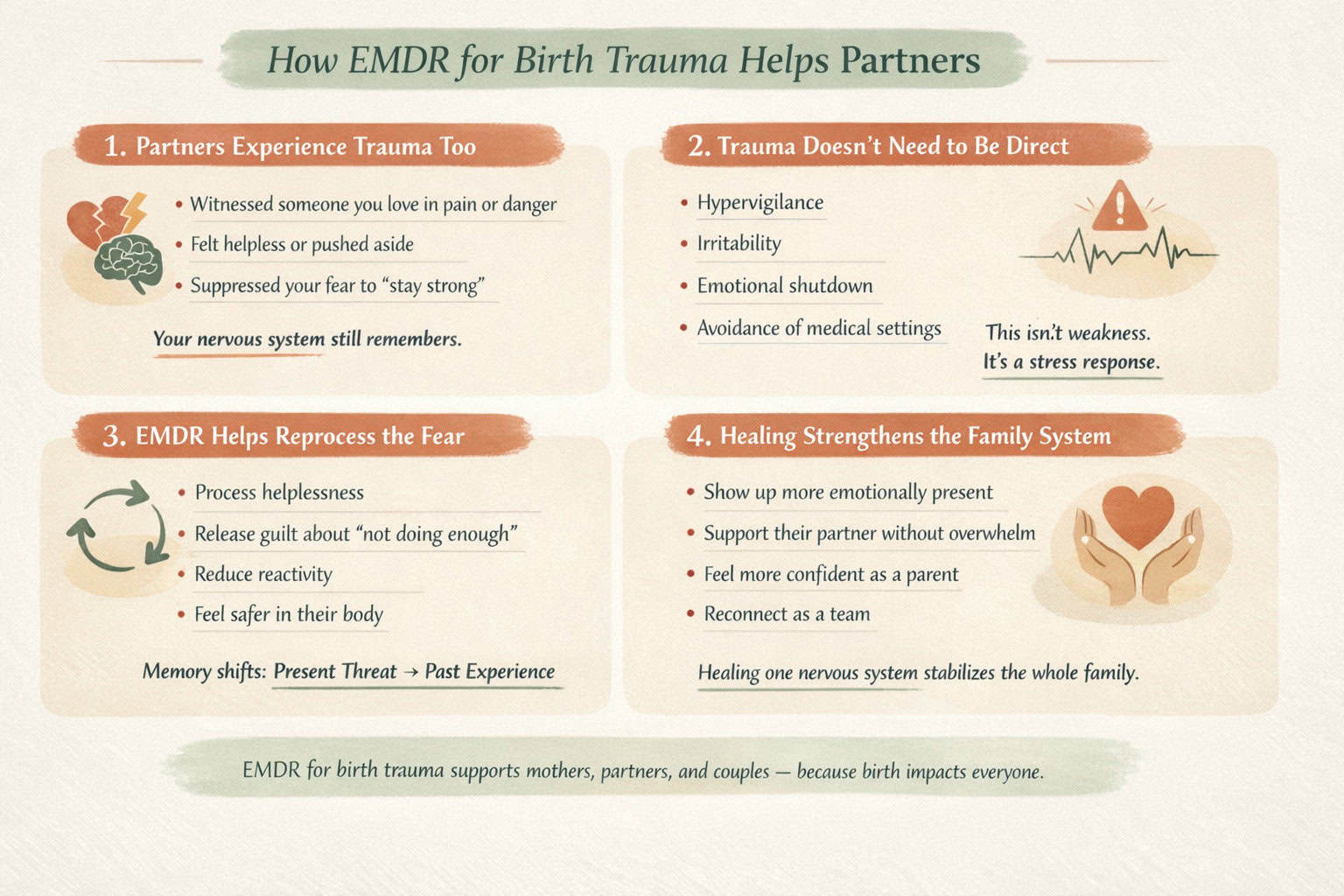
How EMDR for Birth Trauma Helps Partners
Partners often carry a different kind of trauma — the trauma of witnessing.
You may have watched someone you love in pain or at risk. At the same time, you might have felt helpless or pushed aside.
Many partners minimize their experience because they were not the one giving birth. However, your nervous system does not respond to logic. It responds to threat.
EMDR helps partners:
- Process fear and helplessness
- Release guilt about “not doing enough”
- Reconnect emotionally with their partner
- Show up more fully as a parent
When both parents heal, the entire family system becomes more stable.
How EMDR for Birth Trauma Helps Couples Reconnect
EMDR for birth trauma isn’t about changing your story —
It’s about changing how your body holds it, so the past stops interrupting your present.
Birth trauma can reshape a relationship. Even in strong partnerships, a frightening birth may create distance or misattunement.
As a result, couples often notice:
- Increased arguments about small but emotionally loaded issues
- Emotional or physical intimacy feeling harder
- A sense of being misunderstood
- Quiet resentment on both sides
- Avoidance of talking about the birth
These patterns do not mean the relationship is failing. Instead, they signal two nervous systems trying to cope in different ways.
EMDR for birth trauma gives couples a structured, safe way to process what happened. Rather than reliving the event or blaming each other, each partner learns to understand their own trauma response and their partner’s.
Over time, many couples experience:
- Less reactivity
- More compassion
- Renewed teamwork
- The ability to discuss the birth without escalating
Many describe this work as the moment they finally felt on the same team again.
What Healing from Birth Trauma Feels Like
Healing is not about erasing the memory. Instead, it changes the memory’s power over you.
After EMDR, many parents feel:
- Less reactive
- More grounded
- More able to enjoy their child
- More connected to their partner
- More like themselves again
They often sleep better and tolerate stress more easily. In addition, they can respond to their baby without panic or shutdown.
That regained capacity matters. You are not only healing for yourself — you are healing so you can show up for your child, your work, and your relationship.
Support Options for Birth Trauma Healing
Birth trauma affects the whole family. Therefore, healing often requires support tailored to your role and experience.
Individual EMDR Therapy for Birthing Mothers
If the birth left you feeling disconnected or overwhelmed, individual EMDR therapy provides a grounded space to process what happened. This work helps restore safety in your body and rebuild connection with your baby.
Individual EMDR Therapy for Partners
Partners deserve support, too. EMDR allows you to process fear, helplessness, or guilt so you can show up more fully — emotionally and relationally.
Couples Therapy for Birth Trauma
Couples therapy helps partners understand each other’s trauma responses and repair the bond. Together, you can rebuild safety and move forward as a team.
Individual and Couples EMDR Intensives
Some parents need relief sooner rather than later. When you are caring for a newborn, weekly therapy can feel slow.
Intensives provide:
- Extended time for deeper processing
- Focused, personalized care
- Accelerated healing
- Options for individuals and couples
For many families, intensives mark the shift from surviving to truly feeling present again.
You Don’t Have to Carry Birth Trauma Alone
If your birth did not go as planned, your reactions make sense. Healing is possible, and support exists.
If you’d like support, our trauma-specialist team at The Catalyst Center is here for you. Reach out to learn more or schedule a consultation.
Ready to get started?
Our team specializes in helping men navigate stress, burnout, and emotional overwhelm.
If you’re ready to explore how therapy or KAP can help you manage chronic stress, we’re here to help!