
How Trauma Impacts Intimacy and Emotional Closeness
“I got so pissed off, angry at him!”
Her tone supported every word. I listened quietly while she ranted, grounding myself as the intensity rose. Soon, she shifted to another relationship—her mother’s blatant dismissal of her godmother’s death.
As she spoke, I was aware of how her escalation would likely land with the people she loved. They wouldn’t like it. They would fight back or withdraw. Either response would further solidify her position of victimization.
Anger, Emotional Neglect, and Attachment Wounds
Early in my career, I worked at the Kempe Children’s Center for the Prevention and Treatment of Childhood Abuse and Neglect. Our team was trained in the latest trauma and attachment research while working with profoundly painful child cases—burn victims, siblings of shaken babies, survivors of domestic violence.
Yet beyond physical trauma, we consistently encountered the terror of wounded attachments, separation, and loss.
When children experience trauma alongside relational disruption, predictable patterns emerge. Without caregivers who can help regulate and repair those early wounds, children often develop survival behaviors that later interfere with intimacy. Rage, dissociation, and relational volatility are not only signs of pathology—they are adaptations.
The Legacy of Generational Trauma
Selma Fraiberg, a social worker and psychoanalyst, brought this understanding into sharp focus decades ago. In The Ghosts in the Nursery, she described how unhealed trauma passes from one generation to the next, beginning in infancy.
A critical insight shaped our work: many perpetrators were once victims themselves. When trauma remains unhealed, it fuels harm. Healing, therefore, could not come from fight-or-flight responses alone. It required reparative relationships.
This understanding changed everything.
Seeing the Pain Beneath the Protection
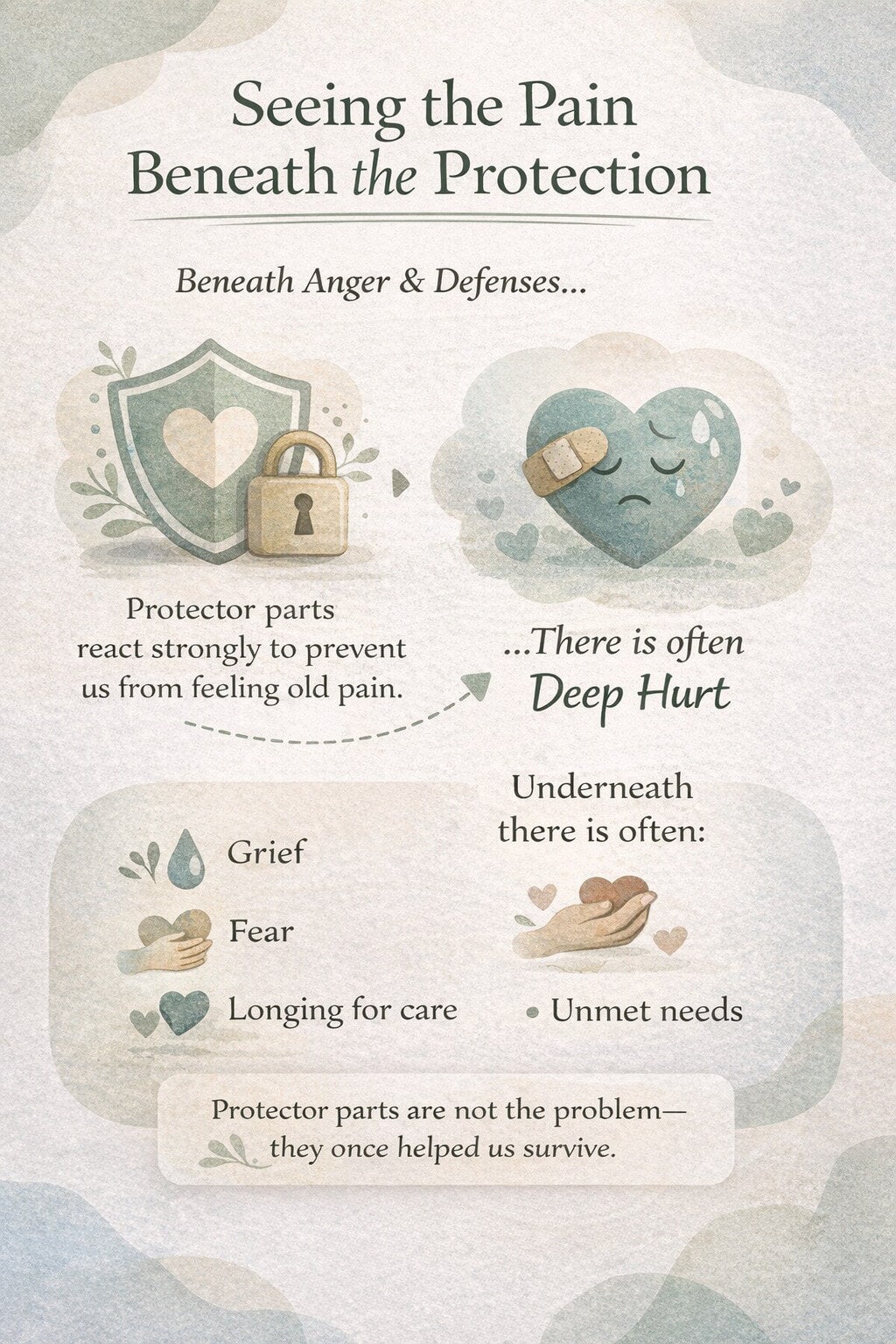
So as I listened to my client’s anger, I knew she wasn’t just reacting to injustice or with poor boundaries—though those mattered. She was hurting.
Through years of trauma training and six years working deeply with IFS, I’ve learned that when anger is strong, profound pain usually lives beneath it. Many approaches attempt catharsis or try to de-escalate intensity. While sometimes helpful, they can miss the deeper opportunity for repair.
IFS offers something different. It allows intense protector parts to soften gently, while honoring the client’s autonomy.
Using IFS to Restore Emotional Closeness
Repairing intimacy after trauma isn’t about pushing yourself to trust —
it’s about building safety inside and between you, one step at a time.
We began with mindfulness, creating just enough space for her to observe the angry part rather than be consumed by it. With curiosity and nonjudgment, she explored why this reaction felt so necessary.
Together, we discovered that the current relational trigger echoed early emotional neglect. Something essential had been missing in childhood.
I spoke the words she had needed to hear long ago—words that helped her make sense of what was happening now. Her anger eased. Her body relaxed.
“How would a child learn this from their parents?” she asked.
When bad things happen, I told her, a good parent responds with understanding and compassion—not denial, judgment or punishment.
Trauma’s Impact on Adult Relationships
Research consistently shows that people with relationship trauma often struggle with distrust, negative assumptions, and communication difficulties. As a result, intimacy can feel dangerous rather than comforting.
And yet, there is real hope.
When a relationship includes secure attachment, studies suggest that partners with complex trauma are more likely to heal and remain engaged. In these cases, I often hear reflections like, “If it wasn’t for my partner’s steady, loving support…” For some, romantic relationships do provide enough protection, guidance, and nurturance to support meaningful repair.
More often, however, partners are not equipped to manage the fallout behaviors that trauma creates. When romantic relationships are asked to heal early emotional neglect on their own, disappointment is common. That disappointment can quietly reactivate the rage of childhood neglect—the terror of feeling unseen, abandoned, or emotionally “cancelled” at a time when survival depended on connection.
This is not immaturity or overreaction. It is the nervous system remembering what it once took to stay alive.
Rebuilding Emotional Safety From the Inside
Healing emotional neglect begins by offering ourselves what was missed.
Backed by neuroscience research, I often invite clients to ask:
What helps me feel safe, seen, soothed, and secure?
For some, it’s a bath, massage, or exercise. For others, it’s baking, nature, music, or rest. Sometimes, it’s simply pausing with self-kindness. It may also mean choosing commitments wisely.
As a wise friend recently said, If there isn’t kindness in it, I don’t do it.
Courage, Tenderness, and Real Intimacy
IFS does not bypass pain. It allows disappointment to be felt while staying connected to Self. This prevents the hardening or withdrawal that often follows relational injury.
Healing intimacy sometimes looks like slowing down, softening expectations, and letting connection emerge naturally.
When we meet our wounded parts with courage and tenderness, emotional closeness becomes possible again—not through force, but through trust.
Ready to get started?
If trauma has impacted your ability to feel close or safe in relationships, support can help. The trauma-specialist team at The Catalyst Center is here to walk alongside you with compassion and care.