

Why Ketamine’s Subjective Effects Matter in Healing Depression
Ketamine has become increasingly recognized as a powerful treatment for depression. For many people, it works when other treatments have failed. However, much of the conversation around ketamine focuses almost exclusively on brain chemistry — how quickly it reduces symptoms, how it affects neurotransmitters, and how long the relief lasts.
Yet something essential is often overlooked.
During ketamine treatment, people frequently report profound subjective experiences: altered perception, a sense of leaving the body, encounters with imagery or emotion, and moments of deep insight or disorientation. Traditionally, psychiatry has labeled these experiences as dissociative side effects — interesting perhaps, but ultimately irrelevant to healing.
Increasingly, this assumption is being questioned.
In fact, ketamine’s subjective effects may not be incidental at all. They may be central to how healing actually occurs.
The Limits of a Symptom-Only Model
Modern psychiatry tends to understand depression as a disorder of brain chemistry. From this perspective, the goal of treatment is simple: reduce symptoms as efficiently as possible.
Within this framework, ketamine’s antidepressant action is often explained through its effects on glutamate and neural connectivity. While this explanation is important, it is incomplete. It does not fully account for why ketamine works so rapidly, nor why attempts to replicate its antidepressant effects without the subjective experience have largely failed.
In fact, pharmaceutical efforts to isolate ketamine’s biochemical benefits while removing its altered states of consciousness have repeatedly fallen short. When the experience is stripped away, much of the healing power seems to disappear.
This raises a crucial question:
What if the experience itself is part of the medicine?
Rethinking “Dissociation” in Ketamine Therapy
Leading voices in ketamine-assisted psychotherapy, including Phil Wolfson and Gita Vaid, have argued that psychiatry’s dismissal of ketamine’s subjective effects is deeply misguided. Labeling these experiences as mere side effects reflects a broader discomfort within Western medicine toward altered states of consciousness.
However, from a therapeutic standpoint, these altered states may be precisely what allows change to occur.
Rather than viewing dissociation as a problem, depth-oriented and transpersonal approaches invite a different understanding: dissociation can temporarily loosen rigid patterns of identity, perception, and meaning. When these patterns soften, new possibilities emerge.
For someone suffering from depression, this loosening can be life-saving.
Depression as Disconnection, Not Just Dysfunction
From the perspective of depth and transpersonal psychology, depression is not simply a chemical imbalance. It is a state of profound disconnection.
A person experiencing depression may feel cut off from themselves, from others, from meaning, or from life itself. Thought patterns become rigid and repetitive. Emotion may feel blunted or overwhelming. The inner world collapses into narrow loops of regret, anxiety, or numbness.
In this state, insight alone is often insufficient. Telling someone to “think differently” rarely reaches the deeper layers where suffering lives.
Healing, from this viewpoint, requires reconnection — and reconnection is not a purely cognitive process. It is experiential.
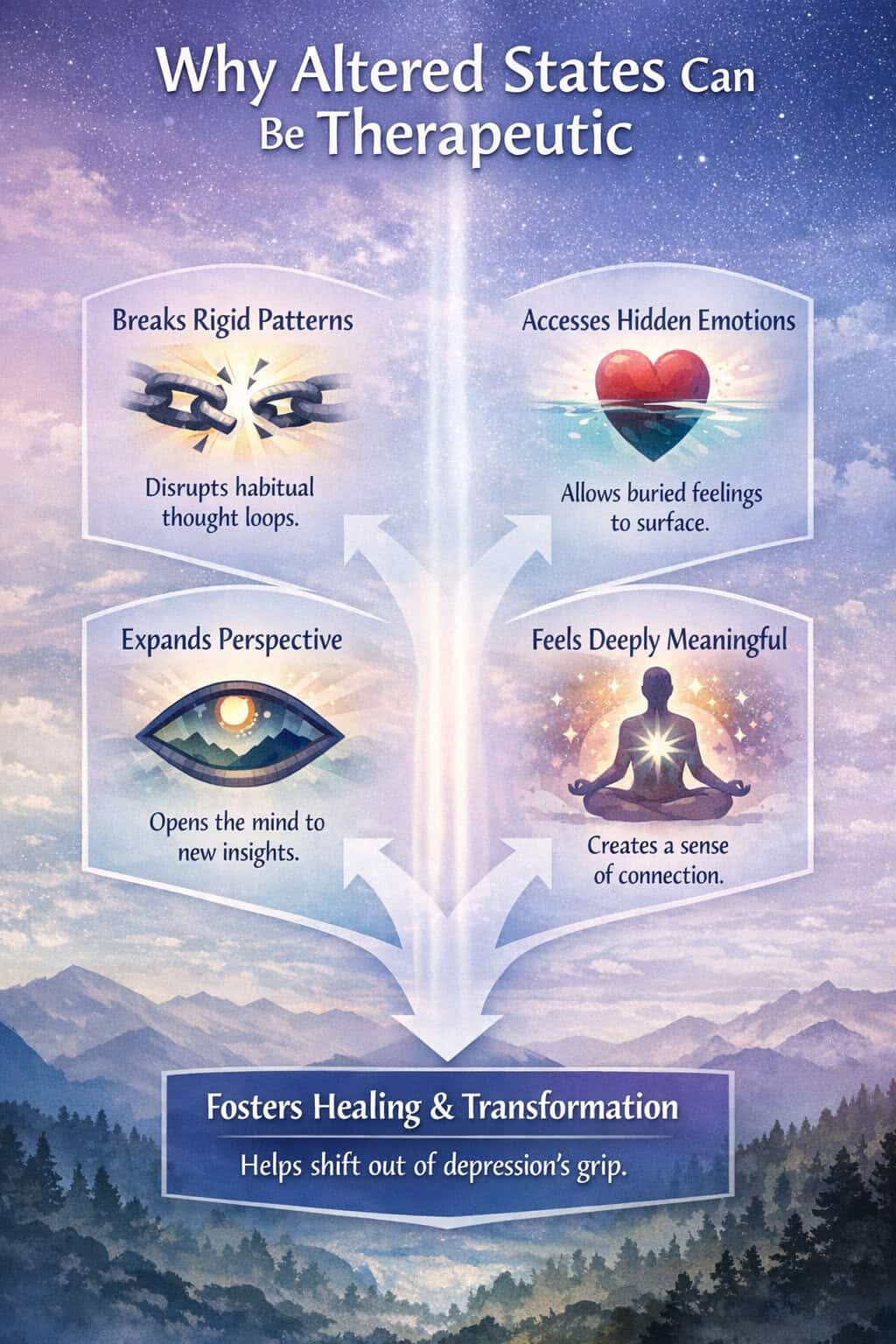
Why Altered States Can Be Therapeutic
Ketamine reliably induces a temporary shift away from ordinary waking consciousness. As external sensory input diminishes and the mind turns inward, people gain access to layers of experience that are usually hidden beneath habitual thought.
This inward movement can feel disorienting. It can also feel expansive, symbolic, emotional, or deeply meaningful. Importantly, it disrupts the default patterns that keep depression in place.
When the familiar structures of identity and narrative loosen, people often encounter aspects of themselves that have long been avoided or forgotten. Emotions that were too painful to feel may arise. New perspectives may emerge without effort.
From a depth-oriented lens, this is not pathology. It is contact with the psyche.
The Role of Surrender in Healing
Ketamine-Assisted Psychotherapy isn’t just about reducing symptoms —
It’s about reconnecting with parts of yourself that depression has pushed out of reach.
One of the paradoxes of depression is that healing often requires letting go rather than trying harder. Yet letting go can feel terrifying, especially for individuals whose sense of safety depends on control, certainty, or perfection.
Ketamine’s subjective effects gently interrupt these control strategies. By altering perception and dissolving familiar reference points, the experience invites surrender.
This surrender is not passive. It is an active willingness to encounter the unknown.
For many people, this is the first time in years that they experience relief from the relentless effort of managing their inner world. In that relief, something begins to move again.
Why Experience Cannot Be Separated From Outcome
If ketamine’s antidepressant effects were purely biochemical, we would expect drugs that mimic its neurochemistry to work just as well. The fact that they often do not suggests that something else is at play.
The subjective experience appears to be part of the mechanism of change.
Altered states allow people to step outside the rigid mental frameworks that define depression. They create space for new meaning, new relationships to emotion, and new ways of being with oneself. When paired with psychotherapy, these experiences can be integrated into lasting psychological change.
Without integration, the experience may fade. Without the experience, integration has nothing to work with.
Toward a More Complete Understanding of Ketamine Therapy
Understanding ketamine solely through the lens of symptom reduction limits its potential. When we include subjective experience as a meaningful component of healing, a richer picture emerges.
Ketamine-assisted psychotherapy is not just about quieting symptoms. It is about restoring movement where there has been stagnation, connection where there has been isolation, and openness where there has been fear.
For people struggling with depression, this shift in perspective can be profoundly hopeful. It reframes healing not as fixing what is broken, but as reconnecting with what has been lost.
In the posts that follow, we’ll explore this process more deeply — including why ketamine experiences often resemble near-death states, how ancient wisdom traditions can help us understand them, and how surrender, paradox, and integration play essential roles in healing.
If you’re curious about whether ketamine-assisted psychotherapy may be right for you, or if you want to learn more about how these experiences can be held safely and meaningfully, our clinicians are here to support you.
Ready to get started?
If you’re exploring ketamine-assisted psychotherapy or wondering whether this approach might support your healing, our trauma-specialist clinicians at The Catalyst Center are here to help. Reach out to learn more or to begin a thoughtful, supportive conversation.