
Ketamine and Near-Death Experiences in Therapy
Many people who undergo ketamine-assisted psychotherapy report experiences that feel difficult to put into words. Time may dissolve. The sense of having a body may fade. Some describe moving through tunnels of light or encountering symbolic presences.
These experiences often feel deeply meaningful — sometimes among the most important moments of a person’s life.
Interestingly, the connection between ketamine and near-death experiences is not merely poetic. Decades of research suggest the overlap may be grounded in shared neurobiology. Understanding this connection helps explain why ketamine can be so transformative in the treatment of depression.
What Is a Near-Death Experience?
Near-death experiences (NDEs) are reported by individuals who come close to physical death through cardiac arrest, trauma, or medical crisis. Across cultures and belief systems, these experiences show striking similarities.
Common features include:
- A sense of leaving the body
- Loss of ordinary bodily awareness
- Intense visual imagery, often involving light
- A feeling of timelessness
- Encounters with beings or presences
- A sense of unity, peace, or clarity
Importantly, many people report lasting psychological changes afterward. For example, some experience reduced fear of death, increased compassion, and renewed meaning.
This raises an important question: Why would an experience associated with dying lead to healing?
Ketamine and Near-Death Experiences: The Neurobiological Overlap
Over several decades, researchers have compared the subjective effects of ketamine with near-death experiences. Among psychoactive substances studied, ketamine most consistently reproduces core features of NDEs.
Psychiatrist Karl Jansen was among the first to propose that ketamine mirrors neurochemical processes involved in near-death states. Later research supported this observation, noting overlap in both experience and brain activity (Jansen, 1997; see also recent reviews in Frontiers in Human Neuroscience).
Unlike classic psychedelics, which primarily affect serotonin systems, ketamine works differently. It blocks NMDA receptors, which play a key role in processing sensory input.
As a result, the brain receives far less information from the external world.
At the same time, ketamine increases glutamate activity in other regions. Therefore, awareness remains active even as sensory input quiets.
The result is paradoxical:
- Awareness remains active.
- External input quiets.
- Consciousness turns inward.
In everyday life, our sense of self is reinforced by constant sensory feedback. When that feedback drops away, the usual structure of identity loosens.
This inward turn is not pathological. Instead, it represents a shift in how consciousness organizes itself.
Ego Dissolution and the Inward Turn
From a depth psychological perspective, inward states often reveal what some traditions call the Self — a deeper organizing center of the psyche beyond everyday identity.
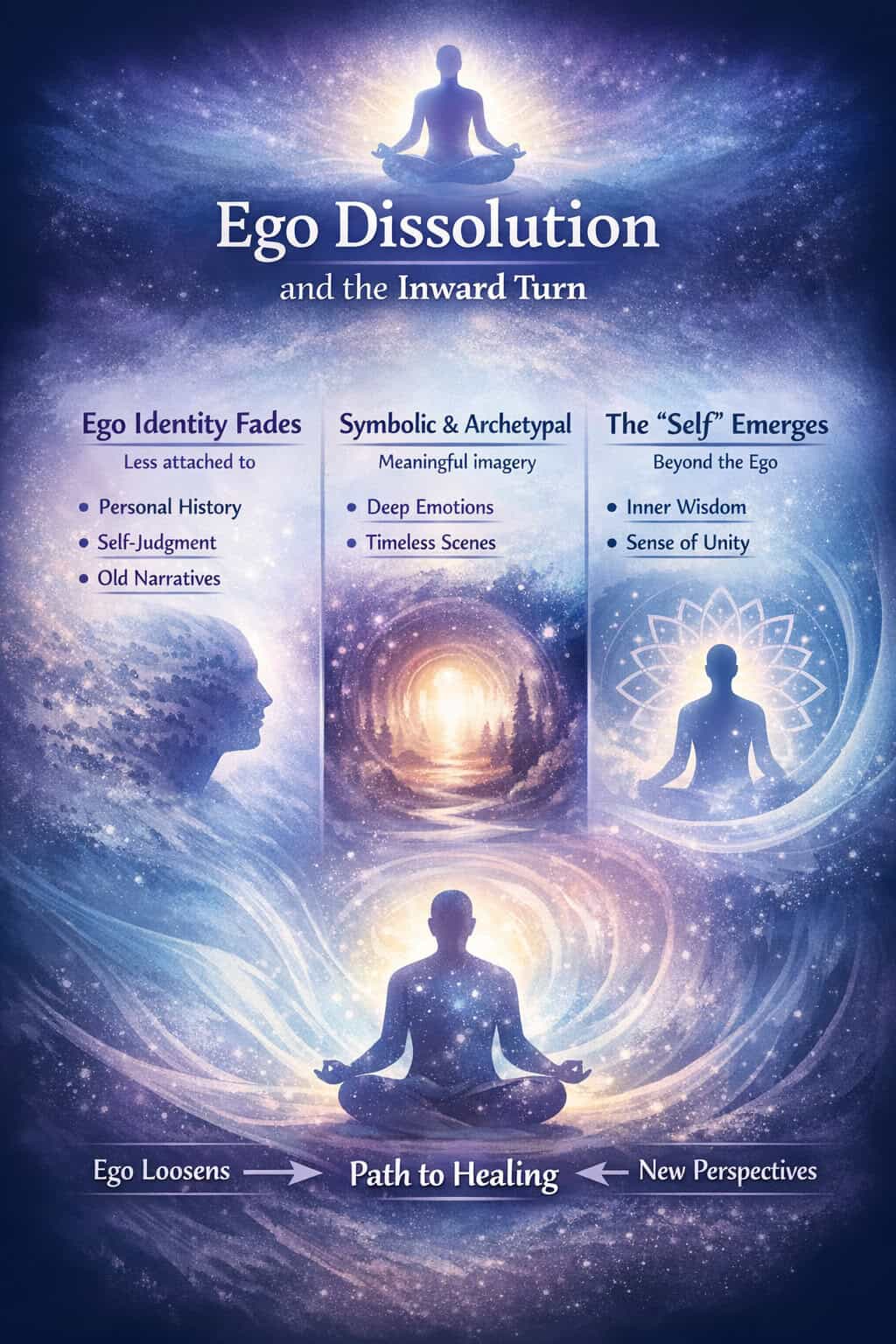
During ketamine experiences, people frequently feel less identified with their history, self-judgment, or habitual narratives. Experience becomes more symbolic and archetypal. The familiar sense of “me” temporarily softens.
Psychologically, this shift may be central to healing. Depression often involves rigid identification with painful self-stories: I am broken. Nothing will change. This is who I am.
Ketamine and near-death experiences both interrupt this identification.
When the ego loosens, new perspectives can emerge.
Why “Dying” Can Be Therapeutic
Ketamine-assisted psychotherapy isn’t about escaping reality —
it’s about turning inward long enough to loosen what no longer serves you.
In both NDEs and ketamine journeys, people often describe profound peace once resistance falls away.
From a therapeutic standpoint, this moment matters.
Depression is often maintained by defensive holding patterns — control, avoidance, perfectionism, or emotional numbing. Ketamine temporarily bypasses these defenses. As a result, deeper emotional material can surface.
Initially, this contact may feel intense. However, when supported within a safe therapeutic container, it often leads to insight and reconnection.
In this sense, the resemblance to death is symbolic rather than morbid. Something old loosens so that something new can emerge.
Why Safety and Context Matter
Ketamine-assisted psychotherapy provides structure and support for navigating ego dissolution and symbolic imagery. With guidance, experiences that feel disorienting can become meaningful.
For more on how sessions are structured, you can read our guide to [Ketamine-Assisted Psychotherapy at The Catalyst Center].
The goal is not escape. Instead, it is a controlled encounter with impermanence and transformation.
From Inward Turning to Healing
When people return from near-death experiences, they often report feeling more alive and less afraid. Ketamine appears to offer a similar psychological opportunity without physical danger.
By turning consciousness inward, ketamine reorganizes how a person relates to their emotions and identity. For individuals living with depression, this reorganization can be profoundly healing.
In our next post, we will explore how Tibetan Buddhism developed detailed maps for navigating in-between states of consciousness — and why those maps remain relevant for ketamine therapy today.
Ready to get started?
If you’re curious about ketamine-assisted psychotherapy, our trauma-specialist team at The Catalyst Center is here to help. Reach out to learn more or schedule a consultation.