
When the Accident Is Over—but Your Life Still Feels Changed
A car accident may last only moments, yet its impact can quietly reshape daily life. Even after medical care is complete, many people notice that something still feels off.
In our practice, we often hear clients say things like, “I have to do positive self-talk and deep breathing before I can even drive now.” Others describe avoiding the area where the accident happened, taking longer routes, or panicking when a partner suggests driving somewhere. These aren’t unusual reactions. They’re signs that the nervous system is still carrying the impact of what happened — even when the body has healed.
This isn’t a personal failure. It’s how trauma works.
The Emotional Impact of Car Accidents Is Often Overlooked
After an accident, most people focus on what feels urgent. You see the doctor, attend physical therapy, visit the chiropractor, and sometimes work with an injury lawyer. Those steps matter. They address real injuries and real stressors.
Yet, what often gets left out is emotional healing—not because it isn’t needed, but because no one tells you to prioritize it. Your body is being treated, your case is being handled, but your nervous system is still carrying the shock of the accident.
Trauma doesn’t always show up as obvious panic. Sometimes it looks like taking long routes to work to avoid certain intersections. Sometimes it means no longer driving your kids to activities because the anxiety feels overwhelming. For others, it’s poor sleep, racing thoughts, body aches, or difficulty concentrating during the day.
These are signs that the brain and body are still stuck in survival mode.
Car Accident Trauma Is More Common Than You Think
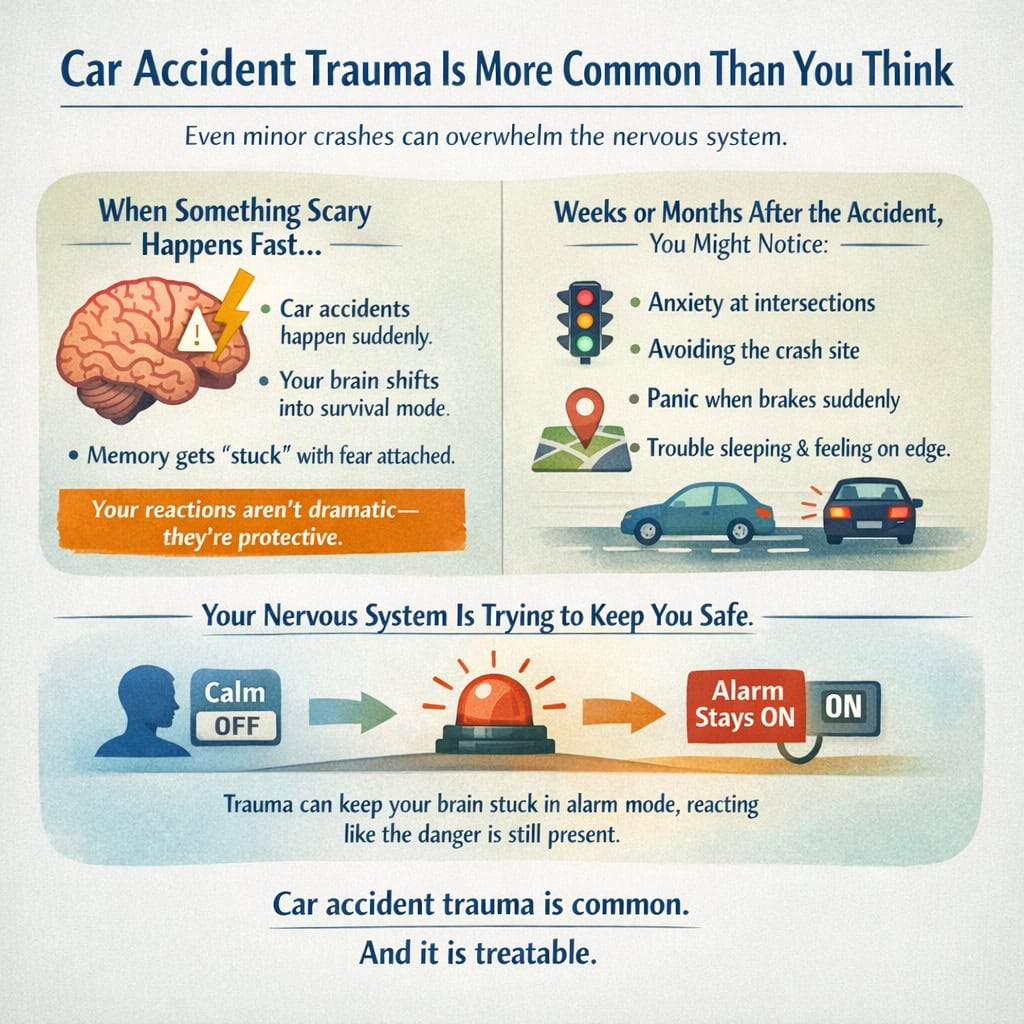
Car accidents are one of the most common causes of trauma. Even minor accidents can overwhelm the brain and nervous system.
When something terrifying happens suddenly, the brain may not have time to process it fully. The memory can remain “stuck,” along with the fear and physical sensations that came with it.
Therefore, certain sights, sounds, or situations—like brake lights, intersections, or sudden stops—can trigger anxiety or panic. These reactions often feel automatic because they are. Your nervous system learned something in a moment of danger, and it is still trying to protect you.
How EMDR Helps After a Car Accident
EMDR intensives for car accidents aren’t about forgetting what happened —
They’re about helping your nervous system understand that it’s over, so you can drive, sleep, and live with calm and confidence again.
EMDR (Eye Movement Desensitization and Reprocessing) is a trauma-focused therapy that helps the brain process overwhelming experiences.
Rather than talking about the accident over and over, EMDR uses bilateral stimulation—such as guided eye movements or tapping—to help the brain reprocess what happened. Over time, the memory becomes less distressing.
You still remember the accident. However, your body no longer reacts as if you’re in danger.
EMDR is recommended by the World Health Organization, Veteran Administration, and APA as an effective treatment for trauma and PTSD, including car accident trauma.
What EMDR Can Help You Move Through
For car accident survivors, EMDR often targets very real, very specific struggles:
- Fear of driving or riding in a car
- Avoidance of the accident location or similar roads
- Nightmares or intrusive memories
- Constant anxiety or hypervigilance
- Difficulty sleeping or focusing during the day
Instead of forcing yourself to “push through,” EMDR helps you resolve the memory so it no longer runs the show.
Why EMDR Intensives Can Help You Heal Faster—and Move On
For many people after a car accident, life doesn’t slow down enough for weekly therapy to feel workable. You still have work, kids, commutes, appointments, and responsibilities that don’t pause just because you’re struggling.
At the same time, living with untreated trauma can quietly shrink your world. You may be pushing through daily driving while feeling tense the entire time. You might be exhausted from poor sleep, taking longer routes to avoid triggers, or constantly bracing your body for something bad to happen.
When trauma is affecting how you function day to day, waiting months or years to feel better can feel overwhelming—or simply unrealistic.
EMDR intensives offer a different path. Instead of spreading healing out slowly over months, intensives allow you to do focused trauma work over one or several days. This gives your brain and nervous system the space it needs to fully process what happened, often leading to noticeable relief sooner.
Healing doesn’t have to be endless to be effective. For many people, carving out dedicated time for an EMDR intensive—just like you would for physical therapy, medical appointments, or recovery planning—can be a powerful turning point.
Rather than fitting healing into the margins of your life, intensives invite you to prioritize it. The goal is not to rush or force anything, but to help your system resolve the trauma so you can move forward without everything revolving around the accident.
For those who want relief now—not someday—EMDR intensives can offer a focused, compassionate way to reclaim your life.
Why EMDR Intensives Can Help You Heal Faster—and Move On
For many people after a car accident, life doesn’t slow down enough for weekly therapy to feel workable. You still have work, kids, commutes, appointments, and responsibilities that don’t pause just because you’re struggling.
At the same time, living with untreated trauma can quietly shrink your world. You may be pushing through daily driving while feeling tense the entire time. You might be exhausted from poor sleep, taking longer routes to avoid triggers, or constantly bracing your body for something bad to happen.
When trauma is affecting how you function day to day, waiting months or years to feel better can feel overwhelming—or simply unrealistic.
EMDR intensives offer a different path. Instead of spreading healing out slowly over months, intensives allow you to do focused trauma work over one or several days. This gives your brain and nervous system the space it needs to fully process what happened, often leading to noticeable relief sooner.
Healing doesn’t have to be endless to be effective. For many people, carving out dedicated time for an EMDR intensive—just like you would for physical therapy, medical appointments, or recovery planning—can be a powerful turning point.
Rather than fitting healing into the margins of your life, intensives invite you to prioritize it. The goal is not to rush or force anything, but to help your system resolve the trauma so you can move forward without everything revolving around the accident.
For those who want relief now—not someday—EMDR intensives can offer a focused, compassionate way to reclaim your life.
What Healing Can Look Like After EMDR Intensives
Healing after a car accident doesn’t mean erasing the memory. It means the trauma no longer lives in your body and no longer controls your daily life. After EMDR intensives, many clients notice changes like:
- Driving again with little to no fear
- Taking normal routes instead of detours
- No longer having intrusive memories about the accident
- Sleeping more restfully
- Feeling calm on the road and less on edge overall
- More energy and focus during the day
Here’s what clients have actually told us after completing intensive sessions: “The crash memory feels more defused and less sharp. I saw the crash site and didn’t feel anxious.” Another shared, “I was able to make the same left turn as the day of the accident and I felt okay.” One client described how EMDR helped her process not just the accident itself, but everything that followed — feeling scared and alone at the hospital, negative interactions during treatment, and the shame of not being “over it” months later.
For many people, the biggest shift is this: life stops revolving around what happened. The accident becomes part of the past — not something your nervous system keeps reliving in the present.
Ready to get started?
If a car accident has changed how you sleep, drive, or live, our trauma-specialist team at The Catalyst Center is here to help. Reach out to learn more or schedule a consultation when you’re ready.