
Healing Social Rejection Through IFS Therapy
Why is rejection so painful?
Research shows that the psychological experience of social rejection activates pain networks in the brain. This may be because, as infants, we depend entirely on social connection to survive. When connection feels threatened, the brain sends signals of danger and pain.
A 2013 study from the University of California explains this clearly:
“Because of our prolonged period of immaturity, the social attachment system may have co-opted the pain system, borrowing the pain signal to prevent the detrimental consequences of social separation.”
In other words, we are wired to feel social rejection — and to feel it deeply.
How We Adapt to the Pain of Social Rejection
Because social rejection hurts so much, many of us develop sophisticated coping strategies. Sometimes, these strategies reduce our awareness of the pain altogether.
In Internal Family Systems (IFS) therapy, these adaptations are understood as protector parts. Manager parts often step in to help us appear strong, capable, or socially desirable. Firefighter parts may attempt to extinguish pain quickly through withdrawal, anger, or numbing behaviors.
When we think about the vulnerable infant who depends on connection, these strategies make sense. Social systems often reward strength and likability while discouraging vulnerability. As Martha Sweezy writes in IFS and Shame, manager parts frequently operate on the front lines of social life. And often, they help to mask the pain of rejection in order to preserve belonging.
Acute Rejection Sensitivity and ADHD
For others, social rejection is not muted at all. Instead, it is experienced with extreme intensity.
Researchers describe this pattern as rejection-sensitive dysphoria (RSD), which is commonly associated with ADHD and difficulties with emotion regulation. The pain is often described as physical — like being punched or stabbed in the chest.
William Dodson, MD, LF-APA, writes in ADDitude that people with RSD often hunch over, grimace, or clutch their chest when describing these moments. Triggers can include criticism (even constructive), teasing, or perceived rejection.
When this happens, individuals may experience rage, withdrawal, or depressive symptoms multiple times a day. From an IFS perspective, this reflects a nervous system overwhelmed by pain, followed by firefighter parts rushing in to restore equilibrium — sometimes in costly ways.
For many people with ADHD, challenges with emotion-regulation compound this experience. Emotion regulation refers to the skills required to manage emotional responses during social interaction and maintain a sense of belonging.
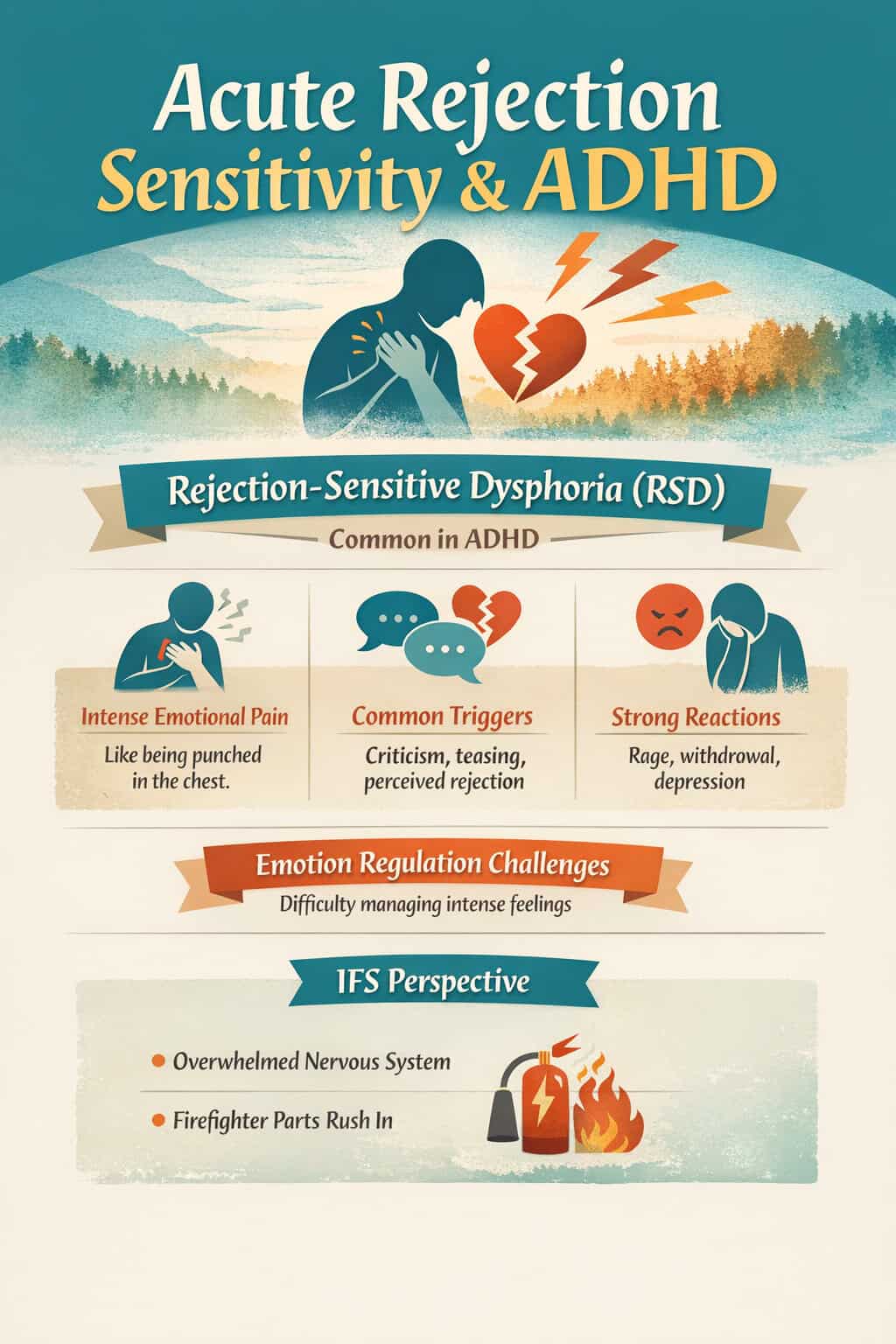
Acute Rejection Sensitivity and ADHD
If you’re reading this, you may recognize this pain in yourself — or you may be witnessing it in someone you care about. IFS therapy offers several pathways toward healing social rejection and relationship wounding.
⸻
1. Nonjudgmental Awareness
Like Mindfulness-Based Stress Reduction (MBSR), IFS begins with attentive, nonjudgmental awareness of present-moment experience. Pain is not rushed away or analyzed immediately. Instead, it is witnessed with curiosity and care.
⸻
2. Decentering From Socially Anxious Parts
IFS helps people decenter from parts that feel socially anxious or rejected. This creates space for self-compassion and cognitive reappraisal, which reduces social anxiety over time.
In IFS, decentering involves:
- Unblending from parts (reducing fusion with painful thoughts or emotions)
- Strengthening Self energy (observing without being overwhelmed)
- Reducing reactivity by differentiating parts from Self
These processes closely align with mindfulness and emotion-regulation research. Studies show that decentering mediates reductions in anxiety, particularly in interpersonal threat contexts like social rejection
(see research summary: https://pubmed.ncbi.nlm.nih.gov/31129975/).
What Decentering Changes
When we decenter, several shifts occur:
- Reduced fusion with rejection-based stories
Observing thoughts rather than identifying with them allows movement from shame toward self-compassion
(https://pubmed.ncbi.nlm.nih.gov/23218023/). - Lower emotional reactivity
In IFS sessions, we repeatedly see that separation from painful parts reduces fight-or-flight responses and restores openness. - Improved flexibility in relationships
Instead of reacting defensively, people respond with curiosity to social cues that once felt disabling. - Less rumination and fatigue
Unblending from protector parts interrupts exhausting cognitive loops and perseverative thinking. - Clearer interpretation of social cues
Decentering reduces threat bias and restores choice in how we respond.
Healing Beyond Insight: Integration and Care
Healing social rejection isn’t about never feeling hurt —
it’s about learning to respond to that hurt with care, clarity, and connection to yourself.
IFS healing goes beyond understanding. It includes a neural reprocessing and integration process rooted in nurturing rather than self-critique.
Healing often involves:
- Relating to pain with warmth instead of approval-seeking
- Setting boundaries that prioritize reciprocity over proving
- Allowing rejection to be information, not indictment
Embodiment is essential here. After rejection, regulation matters more than meaning-making. Warmth, rest, beauty, creativity, nature, food, touch, and rhythm help restore safety.
IFS does not bypass pain. It allows disappointment to be felt while remaining connected to Self. This prevents the common move of hardening or withdrawing from intimacy altogether.
Sometimes healing looks like pausing outreach, softening expectations, and allowing connection to arise organically — without self-abandonment.
Closing Reflection
Social rejection is painful because connection matters. When we learn to care for the parts of us that hurt, rejection no longer defines us. It becomes something we can feel, tend to, and move through — without losing ourselves.
Ready to get started?
If social rejection or relationship wounding feels overwhelming, you don’t have to navigate it alone. The trauma-specialist team at The Catalyst Center is here to support you with compassion and care.